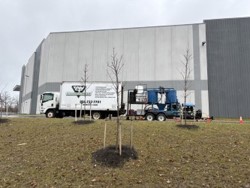
 Remediation of a contaminated site after redevelopment is already complete presents a unique set of challenges. Construction is finished, tenants are incoming, and the tolerance for disruption is minimal. It’s an undertaking that demands precision, adaptability, and a proactive approach to reduce the chances of recurring events.
Project Overview
The customer engaged AWT to address an isolated source area at a recently redeveloped site in Philadelphia, Pennsylvania. The location, now operating as a logistics warehouse, contained dissolved-phase chlorinated volatile organic compounds (CVOCs) in the groundwater surrounding a single monitoring well (MW-4), with concentrations exceeding regulatory criteria.
Because the redevelopment was already complete when remediation was initiated, the approach had to be both effective and minimally disruptive. The consultant selected an aggressive in-situ reductive dechlorination strategy with the goal of reducing contaminant concentrations significantly enough to minimize the likelihood of future remediation events and the operational interruptions they would create for incoming tenants.
Scope of Work
AWT’s scope covered the full injection program from mobilization through site restoration. The work was completed over four days.
Key elements of the scope included:
- Ground penetrating radar (GPR) coordination before installation
- Mobilization of drilling and injection equipment to the site
- Daily transportation of injection dilution water
- Installation of seven temporary injection points (TIPs) surrounding MW-4
- Layout and marking of the injection grid system
- Blending and injection of Provectus Provect-IR® amendments into the subsurface
- Site restoration upon completion
The selected amendment, Provect-IR®, contains a combination of in-situ reductive dechlorination agents, including nutrient-rich organic carbon sources, zero-valent iron (ZVI), chemical oxygen scavengers, and vitamins and mineral sources. A total of 3,500 pounds of Provect-IR® was injected across the seven TIPs, with each location receiving 250 gallons of blended amendment across a 15-foot treatment interval from 15 to 30 feet below ground surface.
AWT’s Drilling and Injection Division used large micro ZVI with a particle size of 40 to 60 microns, selected specifically to provide long-term treatment performance on CVOCs. High-pressure injection equipment introduced the blended slurry into the subsurface, with TIPs installed via direct push using a 7822 drill rig.
Project Management and Coordination
The site presented several challenges that required careful planning and real-time problem-solving from the AWT field team.
Key challenges included:
- Freezing conditions that required additional precautions during blending and injection operations
- Nearby utilities that demanded precise GPR coordination before any ground penetration
- No on-site water source, requiring AWT to transport injection dilution water to the site each day of the program
- Newly constructed infrastructure, including a recently built access road and curbing that required extra care to prevent damage during equipment mobilization and operation
- Tight lithology, as the contaminated zone occurred within sandy silts intermixed with clay, requires careful injection pressure management to achieve adequate distribution of the amendment
The remedial design reflected the site’s particular circumstances. With redevelopment already complete and tenants preparing to occupy the facility, an aggressive approach was appropriate. The amendment selection and injection volumes were intentional, aimed at achieving the kind of contaminant reduction that would minimize the need for future remediation and the disruption that would cause to building operations.
Results and Conclusion
Despite the site challenges, the injection program was completed ahead of schedule and below the estimated budget. Key outcomes included:
- Successful installation and injection of all seven temporary injection points
- Full delivery of 3,500 pounds of Provect-IR® across the target treatment interval
- Site restoration was completed upon demobilization
- Project completed ahead of schedule and under budget
This project illustrates how effective remediation planning and field execution can work together even in constrained, post-redevelopment environments. By anticipating logistical challenges, selecting an appropriately aggressive remedial approach, and executing with precision under difficult conditions, AWT delivered results that restored the site and protected the business operating above it.